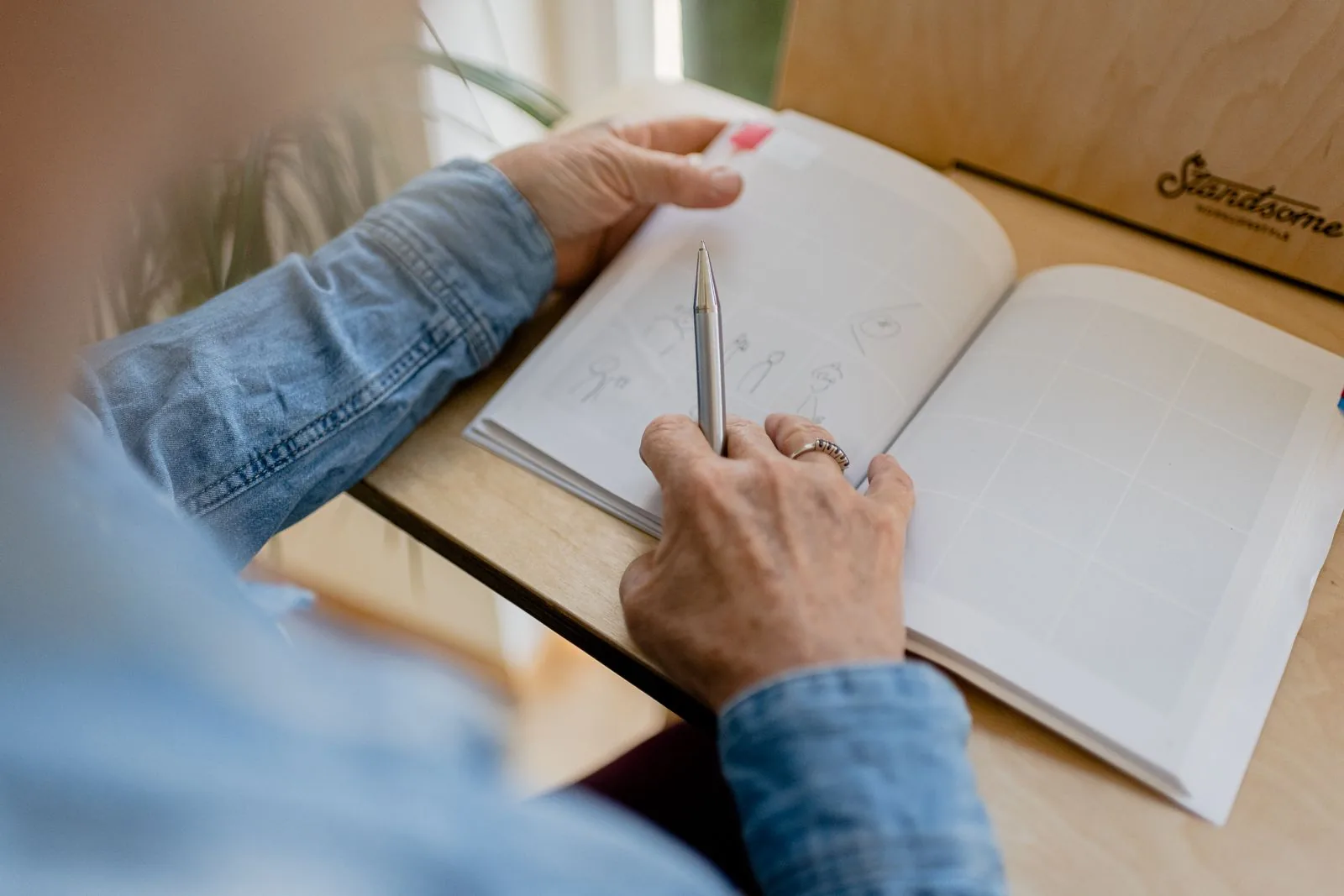
The best pen for sketching, for most people, is a Sakura Pigma Micron: its pigment ink is waterproof once dry, the 6-pack covers 0.20 to 0.50 mm, and it carries a 4.8/5 from 62,200+ Amazon ratings (Nov 2026). If you sketch in ink and then paint, color or wash over the lines, though, the right pen depends on what goes on top. That’s how this guide is sorted.
We may earn a commission when you buy through links on this page, at no extra cost to you. As an Amazon Associate we earn from qualifying purchases.
How we chose
We didn’t test these pens by hand. We compared manufacturer spec pages (Sakura, Faber-Castell, Copic, Pentel, Platinum), the current Amazon listings checked through the Amazon Creators API, the ratings shown on Amazon, and Amazon’s “Customers say” summaries of owner reviews for the real complaints. Where a maker and a retailer disagree, we say so instead of picking the nicer number.
The question that sorted the list: what happens to the line after you draw it? A sketch that stays black-and-white can use almost any pen. A sketch that gets watercolor needs ink that is waterproof when dry. A sketch that gets alcohol markers needs ink that is also alcohol resistant, and fewer pens claim that.
Quick comparison
| Pen | Tip | Line widths in the pack | Ink (maker) | Survives watercolor | Alcohol markers | Refillable | Amazon rating (Nov 2026) |
|---|---|---|---|---|---|---|---|
| Sakura Pigma Micron 6-pack | Plastic fineliner | 0.20, 0.25, 0.30, 0.35, 0.45, 0.50 mm | Pigment, waterproof, chemical resistant | Yes, once dry | Mixed reports (see below) | No | 4.8/5, 62,200+ |
| Faber-Castell Pitt Artist Pen Sketchbook Set | Fineliner, bullet, brush, fude | 0.05, 0.1, 0.3, 0.5, 0.7, 1.5 mm + Fude Medium + Brush | Pigmented India ink, lightfast | Yes, once dry | Not stated by maker | No | 4.7/5, 41 |
| Copic Multiliner Set A2 | Fineliner | 0.03, 0.05, 0.1, 0.3, 0.5, 0.8, 1.0 mm | Pigment, water and alcohol resistant | Yes, once dry | Yes (maker claim) | No (see note) | 4.6/5, 71 |
| Pentel Arts Pocket Brush Pen | Nylon bristle brush | Variable, fine to broad | Pigment, water and fade resistant | Yes, once dry | Not stated by maker | Yes, FP10 cartridges | 4.7/5, 3,200+ |
| Platinum Desk Pen DPQ-700A | Steel fountain pen nib, EF | Extra fine | Depends on cartridge; use Platinum Carbon | With Carbon ink | Not stated by maker | Yes, cartridges or converter | 4.1/5, 858 |
| Pentel Sign Pen S520 | Fiber tip | 1.0 mm | Water-based dye, non-permanent | No, it moves | No | No | 4.6/5, 3,500+ |
1. Sakura Pigma Micron 6-Pack: best all-round sketching pen
The Micron is the default fineliner for a reason you can check: Sakura describes Pigma ink as permanent, fade resistant, chemically stable and pigment-based, and says it won’t bleed or run if liquid hits it after drying. The 6-pack gives you sizes 005 (0.20 mm), 01 (0.25 mm), 02 (0.30 mm), 03 (0.35 mm), 05 (0.45 mm) and 08 (0.50 mm), which is enough to separate outlines, interior lines and hatching in one drawing.
Who it’s for: urban sketchers, watercolor sketchers, anyone filling a sketchbook with line work who wants one dependable pen family.
Who should skip it: heavy-handed drawers who press hard (the fine tips bend), and anyone who wants a refillable pen.
- Pro: waterproof, fade-resistant pigment ink per Sakura, so watercolor washes over dry lines are the intended use
- Pro: six line widths in one pack, with 0.60 and 0.70 mm (sizes 10 and 12) sold separately
- Pro: the largest rating pool on this list, 4.8/5 from 62,200+ Amazon ratings, with owners praising bleed resistance and versatility
- Con: the smallest tips need a light hand; JetPens notes that 003 and 005 can bend and become unusable under pressure
- Con: Amazon’s review summary reports some tips breaking within about six months and some pens arriving nearly dry
- Con: alcohol-marker results disagree. JetPens saw no bleeding with Copic ink after 15 minutes of drying on Rhodia paper; artist Luuk Minkman saw slight bleeding with alcohol markers even after several minutes. Test on your own paper first.
2. Faber-Castell Pitt Artist Pen Sketchbook Set: best starter kit
This set pairs eight black Pitt Artist Pens with a 40-page linen-bound sketchbook (8.25 x 5.25 inches, 20 sheets). The nibs are XXS (0.05 mm), XS (0.1 mm), S (0.3 mm), F (0.5 mm), M (0.7 mm), Bullet (1.5 mm), Fude Medium and Brush, so you get fineliners and brush tips in the same ink. Faber-Castell says the ink is 100% pigmented India ink: lightfast, acid-free, pH-neutral and waterproof once fully dry on porous surfaces.
Who it’s for: beginners who don’t know yet whether they prefer fine lines or brush marks, and gift buyers who want a complete kit.
Who should skip it: fast gesture sketchers who plan to rely on the fude nib, and anyone who already owns a sketchbook they like.
- Pro: the widest range here, from a 0.05 mm fineliner to a flexible brush, all in one ink
- Pro: Faber-Castell says dry Pitt ink can be painted over with watercolor or watercolor pencils without dissolving again
- Pro: sketchbook included, so it works out of the box
- Con: Faber-Castell states Pitt pens are not refillable and the tips are not replaceable
- Con: Faber-Castell’s own FAQ says fude nibs aren’t suited to quick sketches because the ink flow breaks off; they’re built for slow, steady lettering
- Con: this exact set has a small rating pool (4.7/5 from 41 Amazon ratings), so the score says less than the Micron’s
3. Copic Multiliner Set A2: best under alcohol markers
If your sketches get colored with Copic or other alcohol markers, this is the pen whose maker states the property you need. Copic’s official spec says the Multiliner ink is pigment-based, alcohol and water resistant, and acid-free. The A2 set has seven black pens: 0.03, 0.05, 0.1, 0.3, 0.5, 0.8 and 1.0 mm, so it starts finer than the Micron 6-pack and ends bolder.
Who it’s for: marker illustrators, comic and manga artists, anyone who layers alcohol ink over line work.
Who should skip it: watercolor-only sketchers who are happy with a Micron, and buyers who expect refills.
- Pro: alcohol resistance is a maker claim, not just a reviewer observation
- Pro: seven widths from 0.03 mm to 1.0 mm cover hairlines through bold outlines
- Pro: 4.6/5 from 71 Amazon ratings and marked Amazon’s Choice when we checked
- Con: the listing contradicts itself: one bullet says “refillable and replaceable nibs available,” while the description says “not refillable.” The refillable model was the Multiliner SP, and Copic announced in 2026 that the SP line and its cartridges are discontinued once stock runs out. Treat this set as disposable.
- Con: a small rating pool for this specific set compared with the Micron
4. Pentel Arts Pocket Brush Pen: best for expressive line weight
A fineliner draws one width. The Pocket Brush Pen has synthetic nylon bristles, so pressure changes the line from fine to broad in a single stroke. Pentel of America calls the ink permanent pigment ink that’s water and fade resistant, and the pen takes FP10 cartridges; the US pack comes with two refills. Pentel Canada lists about 60 m of writing distance per cartridge.
Who it’s for: sketchers who want thick-and-thin lines, ink-wash style drawings and loose figure work.
Who should skip it: anyone who wants precise, even lines without practice.
- Pro: real bristles give a line range no fineliner matches
- Pro: refillable with cartridges, so you replace ink, not the whole pen
- Pro: 4.7/5 from 3,200+ Amazon ratings; owners call the black dark and the ink flow smooth
- Con: owners report it takes practice and that line thickness is hard to control at first
- Con: the brush wears out; a Stationery Times summary of Pentel Japan’s guidance says to replace the pen after about 2-3 cartridges, depending on use
- Con: if the bristles clog with dried ink, Pentel says to unscrew the tip and rinse it with warm water, which is extra upkeep
5. Platinum Desk Pen DPQ-700A: best fountain pen for sketching
Sketchers know this pen as the “Carbon Desk Pen.” Platinum’s own spec page lists a gold-plated stainless steel EF nib, a recycled AS resin body, 187 mm length, 13.1 mm maximum diameter and 10.5 g weight. The long, light body balances like a dip pen, and the nib gives a slightly livelier line than a fineliner.
The ink is the catch. The pen is only waterproof if you fill it with waterproof ink. Retailers disagree about what ships in the box (Platinum’s page just says a black cartridge, one European shop says four carbon cartridges, another says one), and Amazon owners report mixed waterproof results. Plan on buying Platinum Carbon Ink cartridges (pigmented carbon, 1.2 ml each, 4 per pack) so you know what’s in the pen.
Who it’s for: fountain pen users who want to sketch with ink they can wash over, and anyone who likes a little line variation from a nib.
Who should skip it: people who leave pens unused for weeks, and anyone who wants zero maintenance.
- Pro: refillable with cartridges or a Platinum converter, so the running cost is ink, not pens
- Pro: light at 10.5 g per Platinum, with a long body for a relaxed grip
- Pro: owners in Amazon’s summary praise how fine the line is and say it suits sketching
- Con: pigment carbon ink can narrow the feed if the pen sits; retailer Luiban advises rinsing it with water after a few weeks without use
- Con: 4.1/5 from 858 Amazon ratings, the lowest score here, with mixed reports on ink flow and reliability
- Con: at 187 mm capped it’s long; LarryPOST notes it may not fit a pencil case
6. Pentel Sign Pen S520: best for quick sketches you’ll wash with water
This one breaks the waterproof rule on purpose. The Sign Pen has a fiber tip that draws about a 1.0 mm line with water-based, non-permanent dye ink. Touch a wet brush to the line and the ink moves, which gives quick gray tones from one black pen. For gesture drawing, thumbnails and doodles where you want to work fast and loose, that’s useful.
Who it’s for: quick sketching, thumbnail planning, and anyone who wants soft washes without carrying paint.
Who should skip it: anyone planning watercolor or markers over clean lines, or archival work.
- Pro: a wet brush turns the line into a wash, so one pen gives line and tone
- Pro: 4.6/5 from 3,500+ Amazon ratings for the 12-pack; owners find it versatile for writing, cards and illustration
- Pro: box of 12 means spares are on hand
- Con: non-permanent dye ink, so it’s the wrong pen under watercolor if you want the lines to stay crisp
- Con: the fiber tip is stiff and some owners say it doesn’t hold up well
- Con: one line width only
Which sketching pen fits what you put on top
Start with the medium that goes over the line, because that decides the ink. The tip comes second.
- Nothing, line only: any pen here. The Micron 6-pack is the easiest start; the Pocket Brush Pen if you want thick and thin lines.
- Watercolor or ink wash: pigment ink that’s waterproof when dry. The Micron, Pitt Artist Pens, Copic Multiliner and Pocket Brush Pen all qualify per their makers. Let the ink dry fully first; JetPens waited 15 minutes before its water test.
- Alcohol markers: the Copic Multiliner, because Copic states alcohol resistance. Micron results vary by reviewer, so test a corner of your paper.
- Plain water for quick tones: the Pentel Sign Pen, because its ink isn’t permanent.
- Fountain pen fans: the Platinum Desk Pen with Platinum Carbon cartridges, as long as you’ll use it often or rinse it.
Line width: how many sizes you actually need
Three widths cover most sketching: a fine one (around 0.2-0.3 mm) for details and hatching, a medium one (0.4-0.5 mm) for main lines, and a bold one (0.8-1.0 mm) or a brush for outlines and shadows. Below 0.1 mm the tips get fragile, so buy those only if you draw small and press lightly. If hatching and dotted shading are your thing, our guide to stippling pens goes deeper on the finest tips.
Disposable or refillable
Fineliners on this list are disposable: Faber-Castell says Pitt pens can’t be refilled, and Copic’s refillable SP line is being discontinued. If you sketch daily and hate throwing pens away, the two refillable options are the Pocket Brush Pen (FP10 cartridges, about 60 m each per Pentel Canada) and the Platinum Desk Pen. For more control over the ink itself, a dip pen is the next step; see our dip pen nibs for drawing.
Paper matters as much as the pen
Ink takes longer to dry on smooth, coated paper, and the alcohol-marker bleeding reports above all depend on how long the ink sat. On toned or black paper, black ink disappears; a white gel or paint pen does the highlights, covered in our white pens for black paper guide.
FAQ
What pen do most artists use for sketching?
Pigment fineliners like the Sakura Pigma Micron are the most common choice; Sakura names manga artists, illustrators and watercolorists among its users. The Micron 6-pack’s 62,200+ Amazon ratings show how widely it’s bought, though ratings measure buyer satisfaction, not professional use.
Is a ballpoint pen good for sketching?
A ballpoint works for practice and line studies because you can build tone with light pressure, but most ballpoint ink isn’t sold as waterproof or lightfast. If you plan to paint over a sketch or keep it, a pigment fineliner is the safer pick.
Can I use watercolor over a Micron?
Yes, once the ink is dry. Sakura says Pigma ink won’t bleed or run if liquid is applied after drying, and JetPens’ test let samples dry 15 minutes before soaking them.
Do fineliners bleed under Copic markers?
It depends on the pen. Copic states its Multiliner ink is alcohol resistant. For the Micron, reviewers disagree: one test found no bleeding after 15 minutes of drying, another saw slight bleeding after several minutes. Test on your own paper.
Are fountain pens good for sketching?
They can be, with the right ink. A fine nib with pigmented, waterproof ink, such as the Platinum Desk Pen with Platinum Carbon cartridges, gives lines you can wash over. Regular dye-based fountain pen ink will run under water; our fountain pen ink guide explains the difference.
If you buy only one thing, get the Micron 6-pack for watercolor sketching or the Copic Multiliner set if alcohol markers go on top.
Sources
Checked 2026-11-22.
- Amazon listings via Amazon Creators API and amazon.com product/review summary pages, Nov 2026: ASIN B0008G8G8Y (Micron 6-pack: sizes, rating 4.8 from 62.2K, Customers say), B0CFYFM4KQ (Pitt sketchbook set: nibs, sketchbook size, rating 4.7 from 41), B00251E7BA (Copic Multiliner A2: sizes, refill wording, rating 4.6 from 71), B002LJRKN8 (Pocket Brush Pen: rating 4.7 from 3.2K, Customers say), B006Z10E1S (Platinum Desk Pen: rating 4.1 from 858, Customers say), B00006IFJL (Pentel Sign Pen 12-pack: rating 4.6 from 3.5K, Customers say), B000I5SCNY (Sign Pen 1.0 mm line, dye ink), B003SJ8EEY (Platinum Carbon cartridges, 1.2 ml x 4)
- Sakura of America, Pigma Micron: sakuraofamerica.com/product/pigma-micron (ink properties); new sizes 10 and 12: sakuraofamerica.com/new-pigma-micron
- JetPens, Sakura Pigma Micron guide (water/alcohol test, tip care): jetpens.com
- Luuk Minkman, Sakura Pigma Micron test (alcohol marker bleeding): luukminkman.com
- Faber-Castell USA, Pitt Artist Pen features and FAQ (not refillable, fude nibs): fabercastellusa.reamaze.com; Pitt range: faber-castell.com/pitt-artist-pen; basic techniques (painting over dry ink): faber-castell.com
- Copic, Multiliner spec: copic.jp/en/product/multiliner; Multiliner SP discontinuation notice: copic.jp/en/news/information/20260220
- Pentel Canada, GFKP3 (FP10 refills, 60 m, cleaning): pentel.ca/product/gfkp3; Stationery Times, Pocket Brush Pen guide (Pentel Japan replacement advice): stationerytimes.com
- Platinum Pen, DPQ-700A spec: platinum-pen.co.jp; Luiban (cartridges in box, rinsing advice): luiban.com; Adam eShop (one cartridge): adam-eshop.com; LarryPOST (length, pencil case fit): larrypost.com.au
- Owner notes / photos: none