We may earn a commission when you buy through links on this page, at no extra cost to you. As an Amazon Associate we earn from qualifying purchases.
The best calligraphy pen for most beginners is the Pilot Parallel 3.8 mm.
It gives you real thick-and-thin letters on day one, and it uses cartridges, so there’s no ink bottle to knock over.
But “calligraphy” covers three different tools, and the right pick depends on which look you’re after.
Pick your style first: chisel, brush or pointed pen
Chisel (or “broad edge”) pens have a flat tip, like a tiny screwdriver.
The line gets wide or thin depending on the angle you hold it at, which gives you that classic Gothic or italic look.
Brush pens have a soft, bendy tip.
Press hard and the line gets fat, go light and it gets thin… that’s the modern “hand lettering” style you see on Instagram.
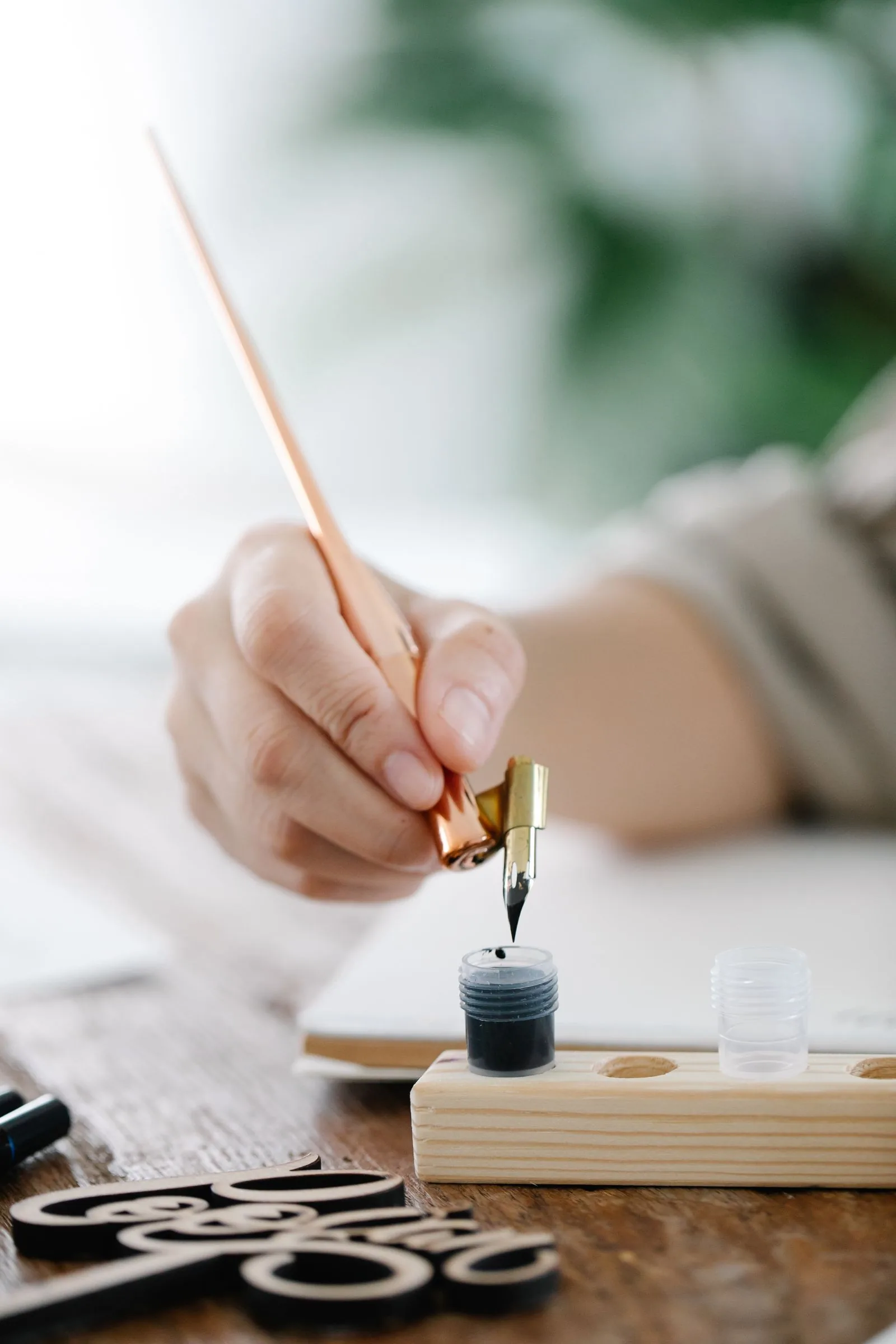
Pointed pens are dip pens with a split, flexible nib (the metal tip).
They make the fancy wedding-invitation scripts called Copperplate and Spencerian, and they’re the hardest to learn.
If you don’t know yet, start with a brush pen or a chisel pen, because neither needs an ink bottle.
How we chose
We didn’t test these pens ourselves.
We compared manufacturer specs, Amazon listing details and Amazon’s review summaries, which pull together what thousands of owners say.
Quick comparison
| Pen | Style | Tip | Needs ink bottle? | Amazon rating (Nov 2026) |
|---|---|---|---|---|
| Pilot Parallel 3.8 mm | Chisel | 3.8 mm parallel plates | No (cartridges) | 4.6/5, 5,900+ ratings |
| Tombow Fudenosuke 2-pack | Brush | One soft, one hard | No | 4.7/5, 41,000+ ratings |
| Itoya Doubleheader | Chisel marker | 1.5 mm and 3.0 mm | No | 4.7/5, 280+ ratings |
| Speedball Oblique Pen Set | Pointed pen | 101 and 103 nibs | Yes | 4.5/5, 1,000+ ratings |
| Zebra G nibs (10-pack) | Pointed pen | G nib | Yes | 4.6/5, 4,300+ ratings |
Pilot Parallel 3.8 mm: best first calligraphy pen
This is a fountain pen built for lettering.
Instead of a normal nib, it has two flat metal plates side by side, so the flat edge makes wide strokes and the narrow edge makes thin ones.
It comes with black and red cartridges, and Pilot also sells it in 1.5, 2.4 and 6.0 mm widths.
3.8 mm is big enough that your mistakes are easy to see, which is what you want while learning.
Good for: Gothic, italic and blackletter practice without dipping.
Skip it if: you want the swirly wedding-script look; that needs a pointed pen.
- Owners call it easy to use and a good fit for broad-edge calligraphy
- Many praise the ink flow
- Touch two Parallel nibs together and the colors blend (per Pilot’s listing)
- Some owners say it bleeds badly with the included ink
- Opinions on the included ink are mixed
Tombow Fudenosuke: best for modern brush lettering
This 2-pack gives you one soft tip and one hard tip.
The hard tip is easier to control, so start there, then move to the soft one once your strokes feel steady.
Good for: cards, bullet journals and that loose, bouncy lettering style.
Skip it if: you want crisp, angular old-world letters.
- Owners say it’s excellent for beginners
- Smooth on the page and easy to handle
- Both the hard and soft tips get good feedback
- Some find the black ink not very dark
- Some owners report the pens dry out quickly
Itoya Doubleheader: cheapest way to try chisel lettering
This marker has a flat chisel tip on each end: 1.5 mm for small writing and 3.0 mm for bold letters.
Itoya says the ink is water-soluble and acid-free, and it comes in six colors.
It’s a good “do I even like this?” test before you spend more on a Parallel.
Good for: envelopes, posters and teens trying calligraphy for the first time.
Skip it if: you need ink that survives a spill, since water-soluble ink runs when wet.
- Two tip sizes in one pen
- 4.7/5 from 280+ Amazon ratings
- No ink bottle, no cartridges, no cleanup
- Far fewer owner ratings than the other picks, so less feedback to go on
- Only two widths, and you can’t refill it
Speedball Oblique Pen Set: best starter kit for pointed pen script
You get one oblique holder, four 101 nibs and two 103 nibs, and Speedball designed it for Copperplate and Spencerian.
“Oblique” means the nib sits off to the side, which helps you hit the steep slant these scripts need.
You’ll need to buy a bottle of ink separately.
Good for: patient beginners who want formal, looping script.
Skip it if: you want quick results this weekend.
- Owners call it beginner-friendly and easy to use
- Reviewers like the flexible nibs and getting several in one pack
- Made in the USA, per the listing
- Some owners find the nibs scratchy, especially the smaller ones
- Several reviewers say the plastic holder feels light and cheap
Zebra G nibs: the easier nib for that holder
If the Speedball nibs feel scratchy, this is the swap owners mention.
Zebra says the G nib is elastic and soft, so the line gets thicker or thinner with pressure.
One reviewer says it’s less likely to catch the paper on upstrokes, and another says it fits the Speedball oblique holder.
Skip it if: you don’t own a nib holder yet; these are nibs only.
- 10 nibs per pack, so a bent one isn’t a disaster
- Owners call them beginner-friendly
- 4.6/5 from 4,300+ Amazon ratings
- They can rust if water gets into the holder
- Some owners report ink transfer and wear issues
Want nibs for art rather than lettering? See our best dip pen nibs for drawing.
Which one should you buy?
Want old-style letters with no mess? Get the Pilot Parallel 3.8 mm.
Want the bouncy style for cards and journals? Get the Tombow Fudenosuke.
Not sure you’ll stick with it? Start with an Itoya Doubleheader.
Dreaming of wedding-invitation script? Get the Speedball Oblique set plus a pack of Zebra G nibs.
Lefties have a few extra things to think about, covered in our best pens for left handers guide.
And if the Parallel gets you hooked on fountain pens, our best fountain pen for beginners list is the next step.
FAQ
What is the easiest type of calligraphy pen for a beginner?
A hard-tip brush pen or a chisel marker, because there’s no dipping and no ink bottle.
Can I use any ink in a Pilot Parallel?
It’s made to refill with Pilot’s own Parallel cartridges, so that’s the safe choice, and Pilot sells a 12-color mixable pack.
Do I need an oblique holder for pointed pen calligraphy?
No, but it helps with slanted scripts like Copperplate, and some owners use G nibs in a straight holder instead.
Sources
- Amazon Best Sellers in Calligraphy Pens (checked 2026-11-06): ratings for ASINs B002RJPPMK, B01M71S9DU, B0027A5ESY
- Amazon listings and review summaries (checked 2026-11-06): Pilot Parallel ASINs B002RJPPMK, B08P3W2G5L, B002UNMZRQ; Tombow B01M71S9DU; Speedball B003IGK0GC; Zebra G B006CQW428
- Itoya Doubleheader product page: itoya.com (checked 2026-11-06): tip sizes, ink, colors